
Capt. Vela's flight office
Capt. Vela · Aerospace · 9 calculators
 Hohmann Transfer OrbitOrbital VelocityMach NumberDrag EquationWing LoadingLift EquationThrust-to-Weight RatioEscape VelocityRocket Equation
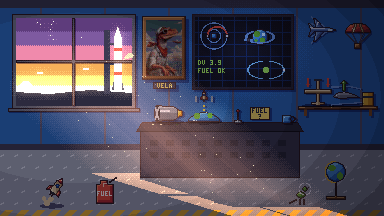
Capt. Vela's office looks out on a launch pad at sunset, a rocket venting on its pad. The mission screen shows a transfer orbit with a satellite going round, model jets hang from the ceiling, and there is a fuel can by the console, just in case. The Aerospace calculators are on the screen, the ceiling, the shelf, the console and the floor.
Two sets of equations carry most of this field. In the air, lift and drag both grow with air density and the square of speed, which is why wing loading, Mach number and thrust-to-weight shape how an aircraft flies. In space, the rocket equation ties the change in velocity a vehicle can make to its exhaust velocity and to how much of its mass is propellant, and orbital mechanics says how much of that change each manoeuvre costs.
The readout on the screen is a favourite number here: a Hohmann transfer from a low circular orbit to geostationary costs about 3.9 km/s of Δv. Fuel, as the sticky note says, is the first thing to check.
“A Hohmann transfer from a low circular orbit to geostationary costs about 3.9 km/s of Δv.” — Capt. Vela
In this office
- Rocket Equation: Solve Tsiolkovsky's rocket equation for whichever of Isp, mass, or delta-v is left blank
- Orbital Velocity: Circular orbital velocity and period at a given altitude
- Escape Velocity: Velocity needed to escape a body's gravity from a given altitude
- Lift Equation: Aerodynamic lift force from airspeed, wing area, and lift coefficient
- Drag Equation: Aerodynamic drag force from airspeed, reference area, and drag coefficient
- Thrust-to-Weight Ratio: Whether a vehicle's engine(s) can lift it off the ground under its own thrust
- Mach Number: Mach number and local speed of sound at a given air temperature
- Wing Loading: Aircraft weight per unit of wing area
- Hohmann Transfer Orbit: Delta-v budget for a two-burn transfer between circular orbits
Project guides
- Plan an Orbital Maneuver: Work out the delta-v an orbital transfer needs, then how much of your rocket's mass has to be propellant to deliver it, and how that changes with the engine.